What language does each stone speak?
Amethyst

Composition: Quartz with iron (Fe, 26 | Si, 14)
Forms inside volcanic geodes over long periods.
Structure: Crystalline
Color Language: Violet/Purple
Cultural & Mystical Use:
In Ancient Greece, amethyst was believed to prevent intoxication and promote clarity of mind. It became associated with discipline, balance, and mental control.
Azurite

Composition: Copper carbonate hydroxide (Cu, 29 | C, 6 | O, 8 | H, 1)
Forms near the Earth’s surface in copper-rich environments as minerals react with water and carbon dioxide over time.
Structure: Monoclinic crystalline (often nodular or massive)
Color Language: Deep Blue
Cultural & Mystical Use:
In ancient cultures, azurite was used as a pigment and was often associated with insight, vision, and expanded awareness. It has long been connected to perception, intuition, and deeper understanding.
Clear Quartz
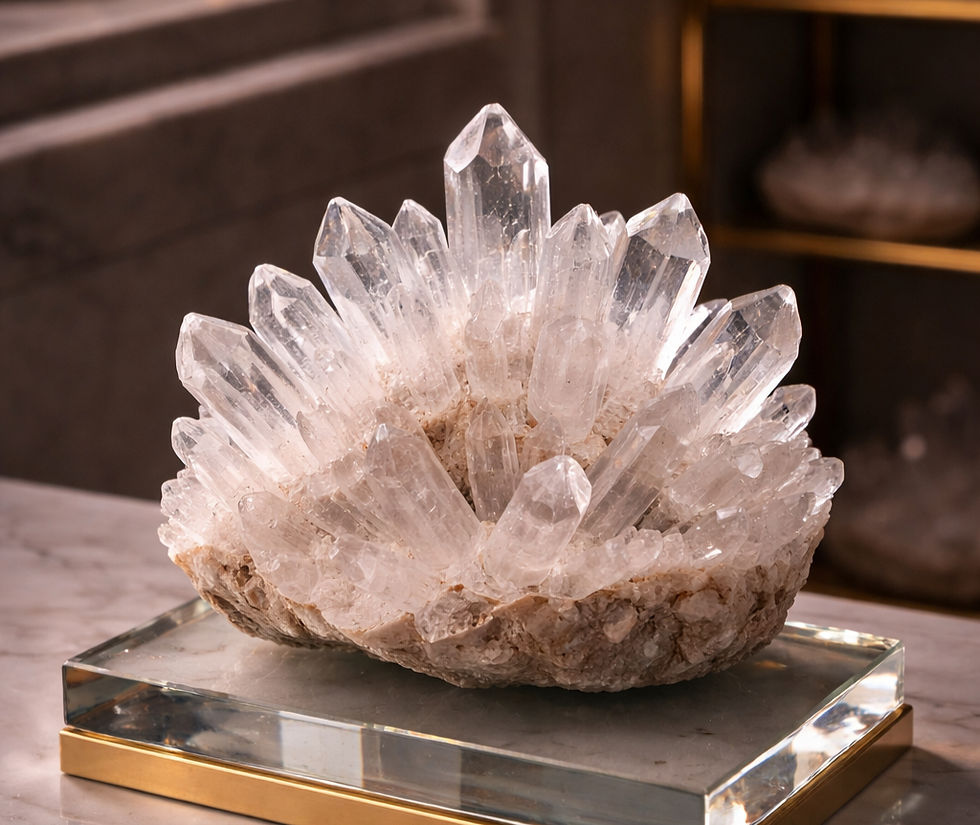
Composition: Silicon dioxide (Si, 14 | O, 8)
Forms from silica-rich solutions that cool and crystallize within cracks and cavities in the Earth’s crust over time.
Structure: Hexagonal crystalline
Color Language: Clear / Transparent
Cultural & Mystical Use:
In ancient cultures, clear quartz was believed to be frozen water, referred to as krystallos by the Greeks. It has long been associated with clarity, amplification, and the enhancement of energy and intention.
Lapis Lazuli

Composition: Lazurite with pyrite inclusions (S, 16 | Al, 13 | Na, 11)
Forms in metamorphic rock as limestone is transformed under heat and pressure deep within the Earth.
Structure: Massive (opaque)
Color Language: Royal Blue with gold inclusions
Cultural & Mystical Use:
In ancient Egypt, lapis lazuli was associated with the heavens, truth, and divine connection. It was used in amulets, burial ornaments, and sacred art, and has long been linked to expression, wisdom, and spiritual authority.